AI Video Quality Race: What Sora, Veo, and Kling Mean for Production Teams
AI video quality is reshaping creative workflows right now. Here's what Sora, Veo, and Kling reveal about consistency, control, adoption, and where production teams should focus next.

By Movi AI Team
Movi AI Editorial Team
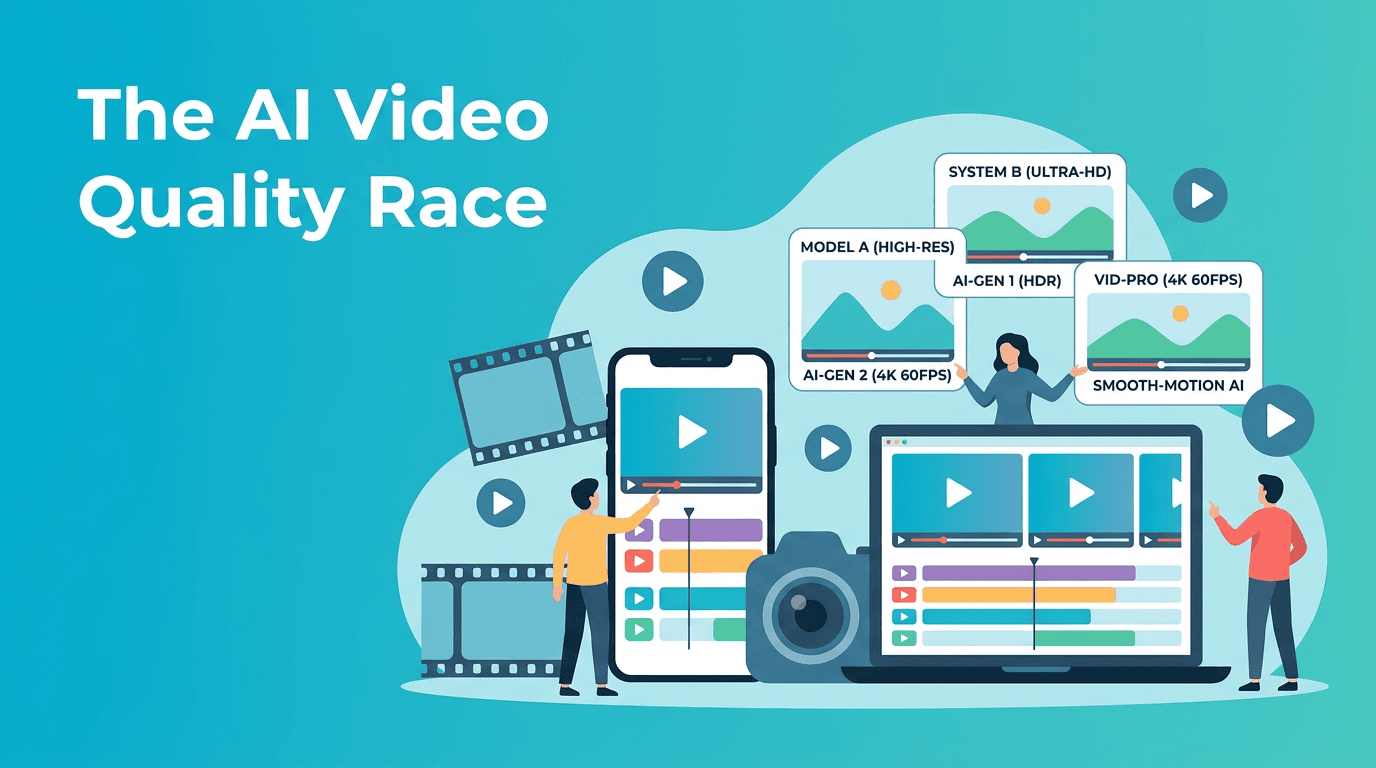
AI video quality is no longer a futuristic talking point. It is the clearest signal of what is happening *now* across the fast-moving AI video industry. The latest model releases, including OpenAI's Sora, Google's Veo, and Kuaishou's Kling, show that competition has shifted from simple novelty clips to consistency, realism, controllability, and production-ready output. For creators, marketers, and media teams, the key question is no longer whether AI-generated clips are possible. It is which tools are becoming reliable enough for real work.
Why the market is now centered on AI video quality
For the last two years, many demos looked impressive in short bursts but struggled with motion physics, character stability, object permanence, and camera continuity. In 2025 and moving toward ai video trends 2026, the discussion has become more practical. Teams want to know whether a model can keep a product shape intact, maintain lighting across cuts, follow a prompt precisely, and output usable formats for Shorts, Reels, ads, explainers, and concept films.
- Quality has become the main differentiator, not just text interpretation.
- Consistency is now as important as realism for repeatable workflows.
- Control layers such as image references, style guidance, and edit-friendly generations matter more than raw wow factor.
- Speed and cost per usable clip increasingly determine adoption inside content teams.
Sora vs other AI video models: what stands out right now
The keyword phrase sora vs other ai video is popular for a reason. Each major platform is pushing a slightly different idea of what progress means. Sora helped define the public conversation with high-fidelity world simulation and cinematic motion. Veo has been associated with strong prompt understanding and tighter connections to Google's broader creator ecosystem. Kling has attracted attention for delivering striking motion and visual detail, especially in social creator communities testing narrative and stylized clips at scale.
OpenAI Sora
Sora has become a reference point for how far ai video technology can go in scene coherence and cinematic behavior. What makes it influential is not just polish, but the idea that a model can simulate richer environments with believable movement. The challenge for teams is availability, workflow fit, and how often outputs are directly editable for production use.
Google Veo
Veo represents the enterprise-friendly side of the market. Google has emphasized quality, prompt fidelity, and ecosystem integration. That matters because professional adoption rarely depends on the model alone. It depends on whether teams can connect generation to planning, editing, publishing, and analytics. This is one reason Veo remains central in ai video news discussions.
Kling
Kling has emerged as a serious competitor by demonstrating that compelling ai generated video quality is not limited to one or two Western labs. It has been widely tested for dynamic motion, stylized content, and fast experimentation. For many creators, Kling helped normalize the idea that model leadership will remain fluid, with different tools winning different categories.
"The next breakthrough in video AI is not just prettier motion. It is dependable motion you can build a workflow around."
What has improved most in AI generated video quality
The biggest quality jump is not a single visual trick. It is the steady reduction of obvious failure points. Hands and faces still require scrutiny, but improvements in temporal consistency, camera motion logic, texture retention, and scene continuity are making more clips usable without heavy repair.
- Temporal consistency - subjects drift less between frames than earlier systems.
- Better motion understanding - walking, turning, and camera movement look more intentional.
- Stronger prompt adherence - models are gradually following scene instructions more faithfully.
- Improved style stability - a chosen look holds up longer within the same clip.
- Editing readiness - outputs increasingly work as inserts, background loops, concept visuals, and ad variations.
Where industry adoption is actually happening now
Current adoption is strongest in areas where short-form, iterative content matters most. Marketing teams are using AI-assisted clips for ad concepts, social tests, product storytelling, and seasonal variations. Entertainment teams are using it for concept development, pitch visuals, and internal pre-production experiments. Newsrooms, educators, and training teams are also testing generated visuals for explainers when speed matters.
Recent market estimates across the broader generative media sector suggest double-digit annual growth and rapidly expanding enterprise trials, with creator tools driving a major share of usage. What matters more than any single forecast is the pattern: companies are not replacing every video workflow, but they are increasingly inserting AI where speed, personalization, and versioning create a clear return.
High-growth use cases to watch
- Performance ad variations for different audiences and offers
- Product visualization before full studio shoots
- Social-first storytelling for Reels, Shorts, and TikTok
- Internal concept videos for brand, agency, and film teams
- Training and education assets with fast visual explainers
- Music and fan content where experimentation matters more than polished perfection
How creators should think about the best ai video generator 2026
The search for the best ai video generator 2026 will not have one universal answer. The better question is: best for what? Some tools will lead in cinematic fidelity. Others will win on mobile speed, ease of use, social formats, editability, or cost. That is where apps like *Movi AI* become especially practical. Instead of waiting for one frontier model to solve everything, creators increasingly need an accessible tool that turns text prompts, images, and existing footage into usable content quickly.
Turn trends into publishable content
Want to test modern video creation workflows without a complex production stack? Use *Movi AI* to create videos from text, images, or existing clips right on your device.
Download Movi AIFor solo creators and lean teams, *Movi AI* fits the real market direction: mobile-first creation, fast iteration, and multiple input modes including text-to-video, image-to-video, video-to-video, and speech-driven creation. That makes it useful in a world where the frontier models shape expectations, but everyday creators still need simple, repeatable workflows.
Predictions: where AI video goes next
Looking ahead, the future of ai video will likely be defined by five shifts. First, models will get better at character consistency across multiple shots. Second, creators will gain more control through reference inputs, camera commands, and scene editing. Third, generation will merge more tightly with editing, so creating and revising happen in one flow. Fourth, platform-specific optimization will become standard, with outputs tailored to feeds, commerce pages, and ads. Fifth, pricing pressure will make high-quality creation more accessible, pushing adoption deeper into the mainstream ai video industry.
- By 2026, multi-shot scene continuity should improve enough for lightweight narrative production.
- Audio-aware generation will become more common, especially for lip sync, pacing, and soundtrack alignment.
- Brand control systems will matter more as agencies seek repeatability across campaigns.
- Compliance, disclosure, and provenance tools will expand alongside adoption.
- Mobile creation apps will capture more of the market as speed and convenience win.
What to do right now if you create video content
- Audit where your current workflow loses time, especially ideation and first-draft visuals.
- Test multiple models and apps for one narrow use case before expanding.
- Measure cost per usable clip, not cost per generation.
- Build a reference library of prompts, images, and brand elements.
- Use AI for speed and variation first, then expand into higher-stakes production as reliability improves.
Frequently Asked Questions
What is the biggest AI video trend in 2026?
The biggest trend is likely to be improved character and scene consistency, which makes AI-generated clips more usable for repeatable workflows and multi-shot storytelling.
Is Sora better than other AI video models?
Sora is influential for cinematic quality and scene coherence, but different models lead in different areas such as speed, control, ecosystem fit, and accessibility.
What is the best AI video generator 2026 for creators?
The best tool depends on your goal. Frontier models may lead in realism, while creator-focused apps like Movi AI are better for fast, practical content creation from text, images, or existing video.
How good is AI generated video quality now?
Quality has improved significantly, especially in motion, prompt fidelity, and visual coherence. However, creators should still review outputs for hands, faces, continuity, and brand accuracy.
Movi AICreate stunning AI videos in seconds!
Turn your ideas into professional videos with the #1 AI video maker.
Download Movi AI