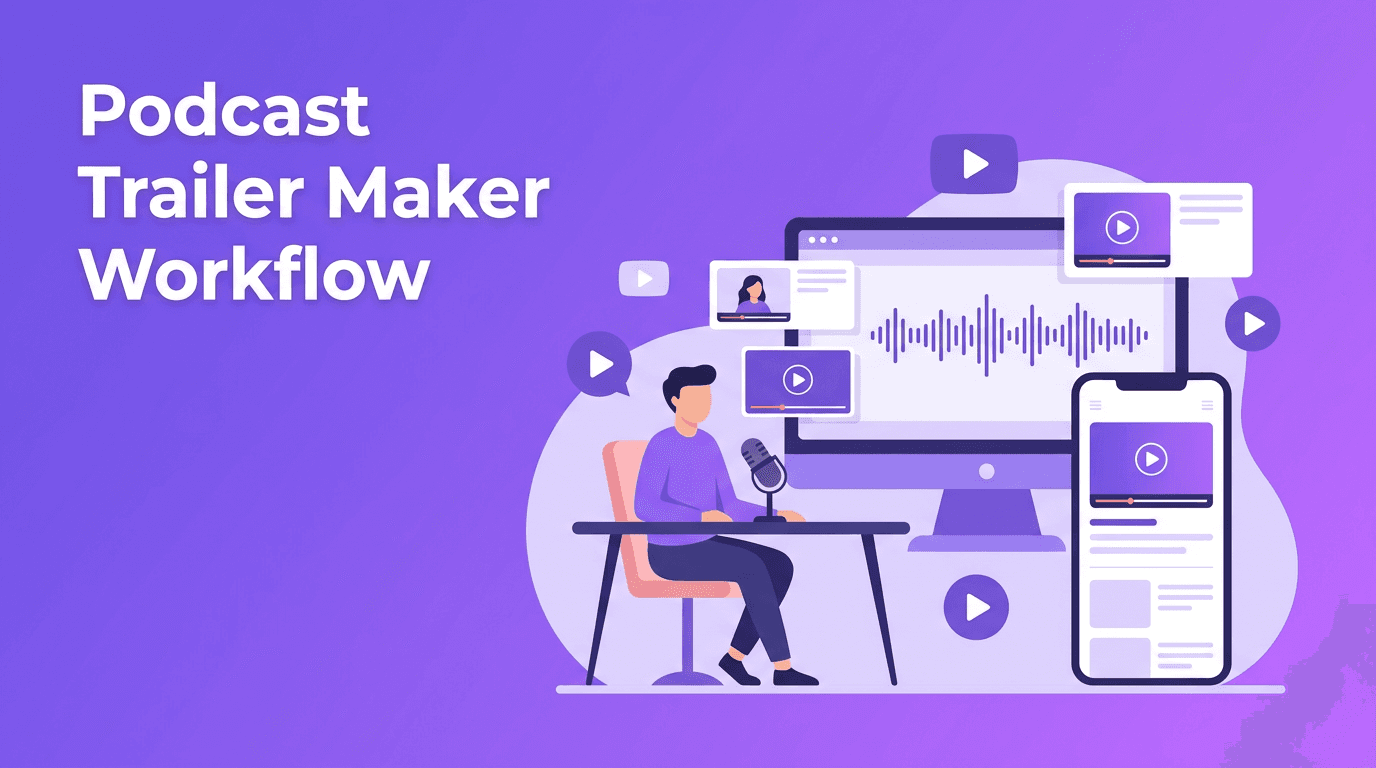
Podcast Trailer Maker: A Fast AI Workflow for Turning Episodes Into Short Video Promos
A practical podcast trailer maker guide for creators who want to turn long episodes into short video promos faster with AI, clear steps, and a smarter editing workflow.

By Movi AI Team
Movi AI Editorial Team
A podcast trailer maker workflow helps creators turn long audio episodes into short, watchable promos without spending hours in a timeline. If you want a repeatable way to publish more clips, teasers, and social posts, this tutorial shows how to plan, cut, format, and finish trailer videos faster with *Movi AI*.
Why use a podcast trailer maker workflow
Manual clipping works, but it often means scrubbing through long episodes, resizing for each platform, building captions by hand, and testing multiple hooks one by one. A podcast trailer maker process speeds up those repetitive jobs so you can focus on the message, pacing, and audience retention.
- Before: one full episode, no visual assets, no clear hook, slow export cycle.
- After: 15 to 45 second trailers with captions, visual rhythm, platform-ready sizing, and faster iteration.
- Best use cases: episode launches, guest highlights, quote clips, newsletter promos, and YouTube Shorts teasers.
Step 1: Pick one clear trailer goal
Start with a single goal for each clip. Are you trying to get listens, email signups, or awareness for a guest episode? A short promo performs better when it delivers one idea, not a summary of the entire conversation.
Choose the right source moment
- Look for a strong opinion, a surprising stat, or a useful one-sentence takeaway.
- Select segments with clean audio and emotional energy.
- Avoid inside jokes or context-heavy sections that confuse new viewers.
- Aim for a hook in the first 2 seconds.
"The best promo clip is not the most complete moment. It is the moment that makes people want the next click."
Step 2: Build the trailer structure in minutes
A simple structure keeps editing fast. Use this format: hook -> value -> identity -> call to action. In practice, that means opening with the most interesting line, adding one supporting sentence, showing the show or guest name, then ending with where to watch or listen.
- 0 to 3 seconds: bold hook or unexpected statement.
- 3 to 15 seconds: context or payoff.
- 15 to 30 seconds: show title, guest, or topic framing.
- Final seconds: CTA such as 'Watch the full episode' or 'Listen now'.
Step 3: Turn audio into visual motion with Movi AI
If you only have audio, *Movi AI* can help you create video from prompts, images, voice, or existing clips, which makes it useful for podcasters who need motion without filming everything. You can generate short visual scenes that match the topic, build animated backdrops, or convert still assets into video segments for your trailer.
Practical visual ideas for podcast promos
- Use image-to-video to animate guest photos, cover art, or brand graphics.
- Use text-to-video to create symbolic B-roll for topics like business, fitness, tech, or lifestyle.
- Use speech-to-video to pair spoken audio moments with matching visuals faster.
- Use video-to-video to refresh existing footage into a more stylized promo sequence.
Want a faster way to make podcast promo videos?
Use *Movi AI* to turn prompts, images, audio, and existing clips into polished short videos for your next episode launch.
Download Movi AIStep 4: Make platform-ready versions without rebuilding everything
One of the biggest time drains is re-editing the same trailer for every channel. Instead, create one master clip, then adapt framing, text density, and length for each platform. Your podcast trailer maker workflow should produce multiple outputs from the same source.
- Reels and TikTok: 15 to 30 seconds, faster pacing, larger captions.
- YouTube Shorts: slightly more context, strong headline text, clean ending frame.
- X and LinkedIn: quote-driven cuts with clear topic framing.
- Stories: vertical format with very short text and a direct CTA.
Step 5: Speed up approvals and testing
Do not publish only one version. Create 2 or 3 hooks from the same episode segment and test different opening lines. This gives you a better chance of finding the clip structure that earns the highest watch time.
Simple A/B ideas
- Test a question hook versus a bold statement hook.
- Test speaker-first openings versus topic-first text overlays.
- Test 15-second versus 30-second cuts.
- Test a curiosity CTA versus a direct listen CTA.
Common mistakes that weaken podcast trailers
- Starting too slowly instead of leading with the strongest line.
- Adding too much context before the payoff.
- Using visuals that do not match the spoken topic.
- Ending without a clear next step.
- Publishing one generic cut everywhere without platform adjustments.
Final takeaway
A strong podcast trailer maker system is really a repeatable editing process. When you combine better source selection, a tight structure, fast visual generation, and platform-specific exports, you can promote every episode more consistently without burning hours on manual edits. With *Movi AI*, creators can turn ideas, images, voice, and existing footage into compelling promo videos faster.
Frequently Asked Questions
How do I make a podcast trailer video?
Start with a strong quote or hook, keep the clip short, add clear visual context, and finish with a call to action. Use AI tools to speed up visuals, resizing, and versioning.
What is the best length for a podcast trailer?
For social platforms, 15 to 45 seconds is usually the sweet spot. Shorter clips often perform better when the hook is strong.
Can I turn podcast audio into a video promo with AI?
Yes. AI tools can help pair audio with generated visuals, animated images, text overlays, and short scenes so you can publish video promos faster.
What should a podcast trailer include?
Include a hook, one clear value point, the podcast or guest identity, and a simple CTA such as watch, listen, or subscribe.
Movi AICreate stunning AI videos in seconds!
Turn your ideas into professional videos with the #1 AI video maker.
Download Movi AI