Text to Video AI Explained: Prompts, Models, and Better Results
Learn how text to video AI turns prompts into clips, how different models work, and how to write better prompts for faster, higher-quality video creation.

By Movi AI Team
Movi AI Editorial Team
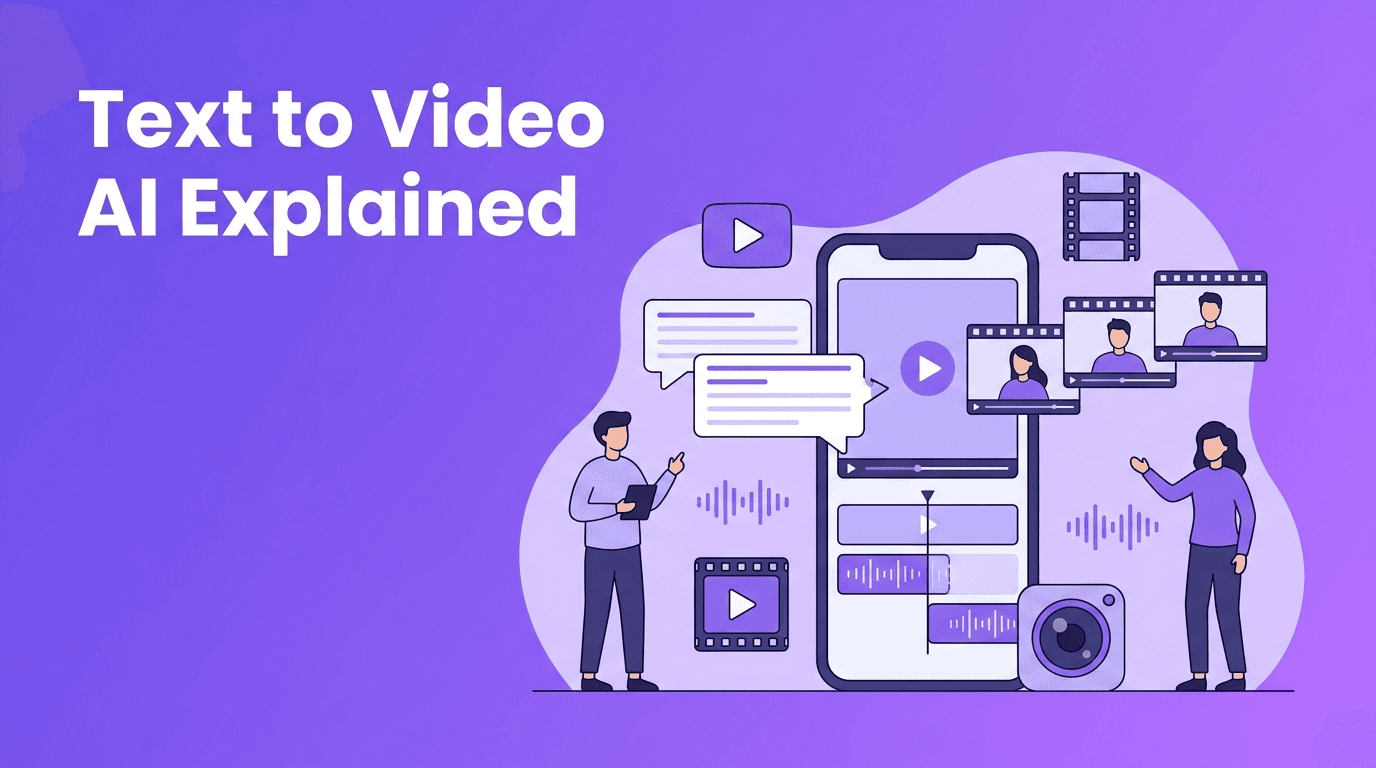
Text to video AI is changing how beginners, creators, and marketers make content. Instead of filming everything from scratch, you can describe a scene in words and let an AI text to video generator turn that idea into motion. If you want to convert text to video, this guide explains the technology, the prompt-writing process, and the settings that improve results.
What text to video AI actually does
At a simple level, text to video AI takes your written prompt, interprets the meaning, and generates a sequence of frames that look like a moving scene. The system tries to understand subjects, actions, camera movement, style, lighting, and composition. Modern tools can generate a short video from a single sentence, then refine it with additional instructions like aspect ratio, duration, and visual style.
- You write a prompt such as: 'A golden retriever running through a snowy park, cinematic camera pan, soft morning light'
- The model maps words to visual concepts like dog, snow, motion, and lighting
- It generates multiple frames while trying to keep the subject and style consistent over time
- The final output becomes a short clip you can download, edit, or reuse in social content
"The quality of AI video output often depends less on writing more words, and more on writing the right words clearly."
How prompts become videos
If you have ever wondered how to create video from text, the answer starts with a few technical steps. First, the model converts your prompt into numerical representations called embeddings. These embeddings help the system connect language with visual patterns learned during training. Then the model generates frames, predicts motion between frames, and applies consistency rules so the video feels coherent instead of random.
The core stages behind an AI video from text prompt
- Text understanding - The AI reads your prompt and identifies objects, actions, mood, style, and scene relationships
- Scene planning - The model estimates what should appear first, what should move, and how the shot may progress
- Frame generation - It creates images frame by frame or in latent space, depending on the model design
- Temporal consistency - It tries to keep characters, backgrounds, and motion stable across frames
- Upscaling and enhancement - Some systems add detail, sharpen textures, or improve smoothness after generation
This is why one prompt can produce different outputs across tools. Each model has different training data, motion handling, style preferences, and safety filters. In practice, that means one text to video app may create more realistic motion, while another is better for animation, product visuals, or stylized scenes.
Diffusion vs transformer approaches
Not all ai text to video generator systems work the same way. Two major approaches dominate the conversation: diffusion models and transformer-based models. Understanding the difference helps you choose the right tool and write prompts that fit the model's strengths.
Diffusion models
Diffusion models start with noise and gradually turn that noise into meaningful visual content. In video generation, they often create frames or latent video representations step by step. This approach is known for strong image quality and detailed visuals, especially when prompts describe appearance clearly.
- Strengths: high visual quality, strong style control, good prompt responsiveness
- Challenges: can struggle with long motion consistency, may need more compute, sometimes slower generation
- Best for: cinematic clips, stylized ads, mood pieces, concept visuals
Transformer-based models
Transformer-based systems are built to model sequences. Because video is naturally a sequence of frames, transformers can be powerful for predicting motion, object relationships, and longer scene structure. Some newer systems combine transformers with diffusion to get better coherence and visual quality together.
- Strengths: better sequence modeling, stronger motion planning, potential for longer clips
- Challenges: quality can vary by implementation, training is complex, outputs may still need refinement
- Best for: storytelling clips, action sequences, multi-step scenes, structured motion
For most users, the takeaway is simple: different models interpret the same prompt differently. If one tool gives unstable movement or weak style, try a different wording or a different model. *Movi AI* makes this process easier by giving creators a user-friendly way to generate and test video ideas without needing deep technical knowledge.
Prompt engineering tips for better video results
Good prompts are specific, visual, and ordered. Bad prompts are vague, overloaded, or contradictory. If you want better text to video results, think like a director: describe the subject, action, setting, camera, style, and output format in a logical sequence.
A simple prompt formula
Use this structure: subject + action + setting + camera movement + lighting + style + aspect ratio + length. You do not always need every element, but this order helps many tools understand your goal.
- Good prompt: 'A barista pouring latte art in a small cafe, close-up shot, slow camera push-in, warm window light, realistic, 9:16, 6 seconds'
- Bad prompt: 'Make a cool cafe video that looks awesome and viral'
- Good prompt: 'A futuristic car driving through a rainy city street at night, low-angle tracking shot, reflections on wet pavement, cinematic, 16:9, 8 seconds'
- Bad prompt: 'Car city night maybe fast, cool style, social media look'
Prompt writing rules that usually help
- Use one clear main subject instead of too many competing objects
- Describe visible actions like walking, turning, pouring, flying, or opening
- Add camera language such as close-up, wide shot, overhead shot, pan, zoom, dolly, or tracking shot
- Specify lighting and mood, for example soft morning light, neon night lighting, dramatic shadows
- Choose a style keyword like realistic, animated, cinematic, claymation, watercolor, or anime
- Set the aspect ratio based on platform needs: 9:16 for Stories and Reels, 16:9 for YouTube, 1:1 for feeds
- Keep clips short and focused when testing, then iterate with improvements
If you are trying to convert text to video for social media, start with 5 to 8 seconds and one main action. Shorter prompts and shorter clips usually make testing easier. Once the core motion looks right, add style details and camera cues.
Quality settings beginners should understand
- Aspect ratio affects composition and platform fit
- Video length affects motion complexity and generation time
- Style strength controls how strongly the visual look follows your chosen aesthetic
- Seed or variation controls can help recreate a similar result with small changes
- Resolution or quality mode impacts detail, speed, and export readiness
Practical ways creators use text to video AI
There is a reason searches for text to video free and text to video app keep growing. The technology saves time and lowers production costs for many common video tasks.
- Social media content - turn campaign ideas into short promotional clips quickly
- Product marketing - visualize product benefits before a full shoot
- Storyboarding - test scenes and camera concepts from a script
- Educational content - illustrate concepts with simple visual sequences
- Small business ads - create polished visuals without hiring a full production team
- Creative experimentation - explore visual styles and concepts before committing budget
Try a simpler way to create AI videos
*Movi AI* helps you generate videos from text prompts, images, and more, with an approachable workflow for beginners and creators.
Download Movi AICommon mistakes when using a text to video app
- Writing prompts that are too vague to visualize clearly
- Adding too many actions in one short clip
- Mixing conflicting styles like realistic, cartoon, documentary, and surreal all at once
- Ignoring platform format, then having to crop important details later
- Expecting the first result to be perfect instead of iterating with prompt changes
The best workflow is iterative. Generate a first version, note what worked, then refine one variable at a time. Change the camera direction, simplify the action, or narrow the style. That process usually improves output faster than rewriting everything from scratch.
Final thoughts on getting better results
Text to video AI is not magic, but it is powerful. The better you understand prompt structure, model differences, aspect ratios, and quality settings, the easier it becomes to create useful clips. Whether you are testing an ai video from text prompt for marketing, education, or social content, a user-friendly tool like *Movi AI* can help you move from idea to video much faster.
Frequently Asked Questions
What is text to video AI?
Text to video AI is technology that turns written prompts into short video clips by generating scenes, motion, and style from language instructions.
How do I create video from text prompts?
Start with a clear prompt that includes the subject, action, setting, camera movement, style, aspect ratio, and clip length. Then generate, review, and refine.
Which is the best AI text to video generator for beginners?
Beginners should look for a tool with simple controls, fast generation, and support for text prompts, images, and editing. Movi AI is designed to make that process easier.
Can I convert text to video for free?
Some tools offer limited free trials or basic generation options. Features, quality limits, and export options vary by platform.
Why do different text to video apps give different results?
Different apps use different AI models, training data, motion systems, and quality settings, so the same prompt can produce very different videos.
Movi AICreate stunning AI videos in seconds!
Turn your ideas into professional videos with the #1 AI video maker.
Download Movi AI