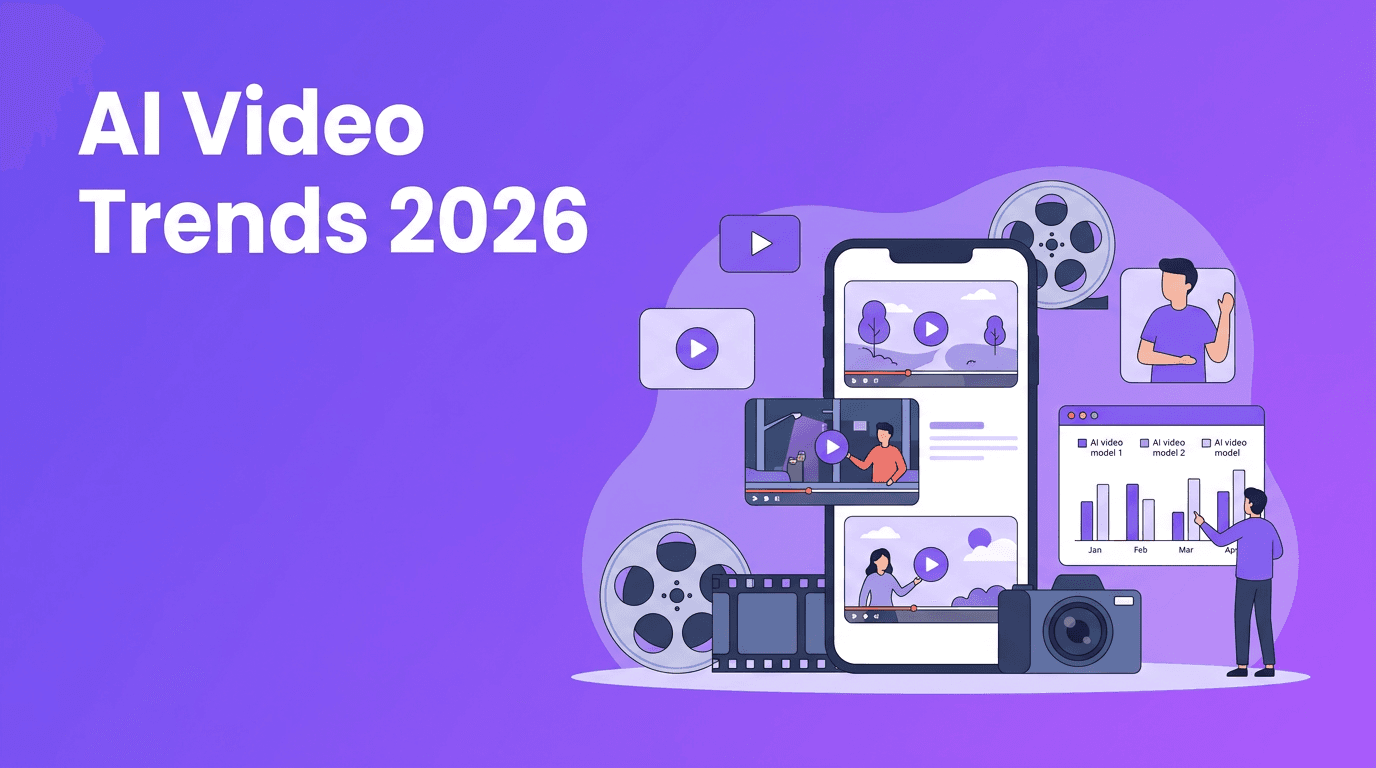
AI Video Trends 2026: What Is Changing Right Now
AI video trends 2026 are unfolding fast, from Sora, Veo, and Kling to sharper motion, better consistency, and wider creator adoption. Here is what is happening now and what it means next.
By Movi AI Team
Movi AI Editorial Team
AI video trends 2026 are already taking shape in the market today. The biggest story is not just that models like Sora, Veo, and Kling can generate impressive clips, but that AI video technology is improving in consistency, controllability, and commercial usefulness at a pace that content creators and brands can no longer ignore.
What is happening now in AI video
The current wave of ai video news is defined by three shifts. First, top models are producing more realistic motion, camera movement, and scene coherence. Second, product teams are focusing on tools that help creators actually finish work, not just generate a flashy demo. Third, the ai video industry is moving from experimentation to integration, with marketing teams, agencies, educators, and app developers testing AI video in real workflows.
- Model race is accelerating as OpenAI's Sora, Google's Veo, and China's Kling push quality expectations higher.
- Editing and generation are converging, with platforms adding prompt-based revisions, style transfer, lip sync, and scene extension.
- Short-form content is leading adoption because social clips, ads, and explainers have faster production cycles and lower risk than long-form film projects.
- Mobile creation matters more as creators expect fast AI workflows on phones, not only desktop interfaces.
Sora, Veo, Kling: why the model race matters
Any discussion of AI video trends 2026 has to start with the model leaders. OpenAI's Sora raised expectations for cinematic scene understanding and longer coherent motion. Google's Veo brought attention to prompt fidelity, cinematic controls, and its broader ecosystem advantage. Kling earned significant interest for delivering strong visual results and helping intensify the global competition around text and image driven video generation.
Sora vs other AI video models
In the sora vs other ai video debate, the practical difference is less about one model winning outright and more about which model fits a workflow. Sora is often associated with high-end realism and narrative potential. Veo benefits from Google's multimodal stack and likely enterprise integration potential. Kling stands out for momentum, visual polish, and pressure on pricing and access. Meanwhile, creators still compare these headline models against production-ready apps that prioritize speed, templates, and publishable outputs.
"The future of AI video will be won not only by the model with the best demo, but by the product that helps creators go from idea to publish faster."
Why AI generated video quality is improving so fast
The jump in ai generated video quality comes from multiple layers of progress. Model architectures are better at preserving object identity across frames. Training data and alignment methods are improving prompt adherence. Inference pipelines are getting more efficient, which helps generate sharper results with fewer obvious artifacts. And post-generation tooling, such as upscaling, interpolation, inpainting, and motion refinement, is reducing the gap between raw output and usable content.
- Consistency across frames is improving, which means fewer morphing faces, unstable hands, or drifting objects.
- Camera motion is more believable, with smoother pans, dolly effects, and depth cues.
- Prompt control is getting stronger, so creators can guide style, composition, and pacing more reliably.
- Audio and speech alignment are becoming more important as speech-to-video and avatar workflows mature.
- Hybrid workflows combining text, images, and source video are producing better outputs than one-shot prompting alone.
The remaining limits creators should watch
Even the best ai video generator 2026 contenders still face real constraints. Complex multi-character interactions can break continuity. Fine-grained control remains inconsistent. Legal and copyright questions are unresolved in many markets. And generation costs, latency, and safety filters still shape what creators can do at scale. In other words, the tools are much better, but not magic.
Emerging use cases driving adoption
The future of ai video is being shaped by use cases that save time or unlock content that was previously too expensive to make. Marketing is the clearest example. Small teams can now turn product shots, scripts, or campaign ideas into multiple ad variations quickly. Educators can create explainers from lesson notes. Publishers can repurpose articles into short clips. Game studios and filmmakers are testing AI for previsualization, concept trailers, and scene ideation.
- Performance marketing teams use AI video for rapid ad testing across different hooks and formats.
- Social creators turn scripts, still images, or voiceovers into daily short-form posts.
- E-commerce brands create product demos and localized promos with lower production costs.
- Internal business teams use AI video for training, onboarding, and sales enablement content.
- Creative studios use AI for storyboarding, mood films, and fast visual prototyping.
Try AI video creation on mobile
Want to test the latest **ai video technology** in a practical workflow? *Movi AI* helps you create videos from text, images, speech, or existing clips right from your phone.
Download Movi AIIndustry adoption and creator economy impact
Recent market reports across generative AI and marketing technology show rising enterprise interest, with many businesses moving from pilot projects to budgeted AI initiatives. While exact AI video adoption rates vary by study and region, the broader pattern is clear: creative automation is entering mainstream workflows. For the creator economy, this lowers the barrier to producing polished videos, but it also raises the bar for originality because more people can now publish at higher volume.
This is where product positioning matters. The winners in the ai video industry will not be the platforms that only generate impressive clips, but those that deliver reliable creation workflows, easy iteration, and formats tailored to social channels. That is why apps like *Movi AI* matter in the broader landscape. They connect advanced generation methods to real creator needs such as speed, accessibility, and mobile-first publishing.
Who benefits most right now
- Solo creators who need to publish more often without hiring full production teams.
- Agencies and marketers that need rapid testing for multiple campaigns.
- Small businesses looking for lower-cost video production.
- Educators and trainers turning information into engaging visual content.
- Early adopters building new media formats before the market gets crowded.
Predictions for the future of AI video
Looking ahead, AI video trends 2026 point toward workflows that are more controllable, multimodal, and personalized. The next phase is not just better generation. It is better direction. Creators will be able to specify camera paths, character consistency, brand styles, dialogue timing, and scene edits with much more precision. Video generation will increasingly feel like collaborating with a production assistant instead of prompting a black box.
- Character consistency will improve enough to support recurring brand mascots, presenters, and episodic content.
- Editing will become conversational, letting users revise scenes with natural language instead of manual timelines alone.
- Personalization at scale will expand, especially for ads, sales outreach, and localization.
- Video and audio generation will merge more tightly, enabling cleaner speech-driven scenes and better sync.
- Platform consolidation is likely, with large ecosystems and nimble apps competing on usability, not just model benchmarks.
The most realistic near-term forecast is that AI video will become a standard layer in content production, not a complete replacement for every traditional workflow. High-end film and brand work will still rely on human direction, editing, and taste. But for everyday content, ideation, testing, and fast-turn marketing, AI video is quickly becoming default infrastructure.
Frequently Asked Questions
What are the biggest AI video trends in 2026?+
The biggest shifts are better video quality, stronger consistency, more controllable prompts, and wider adoption in marketing, education, and creator workflows.
Is Sora better than other AI video models?+
Sora is one of the most advanced names in the space, but the best choice depends on your workflow, access, speed, and the type of content you need to make.
What is the future of AI video creation?+
AI video creation is moving toward more precise control, better character consistency, tighter audio integration, and faster mobile-first production tools.
How are businesses using AI video right now?+
Businesses are using AI video for ads, product demos, training content, social posts, and rapid creative testing across multiple channels.
Create stunning AI videos in seconds!
Turn your ideas into professional videos with the #1 AI video maker.
Download Movi AI