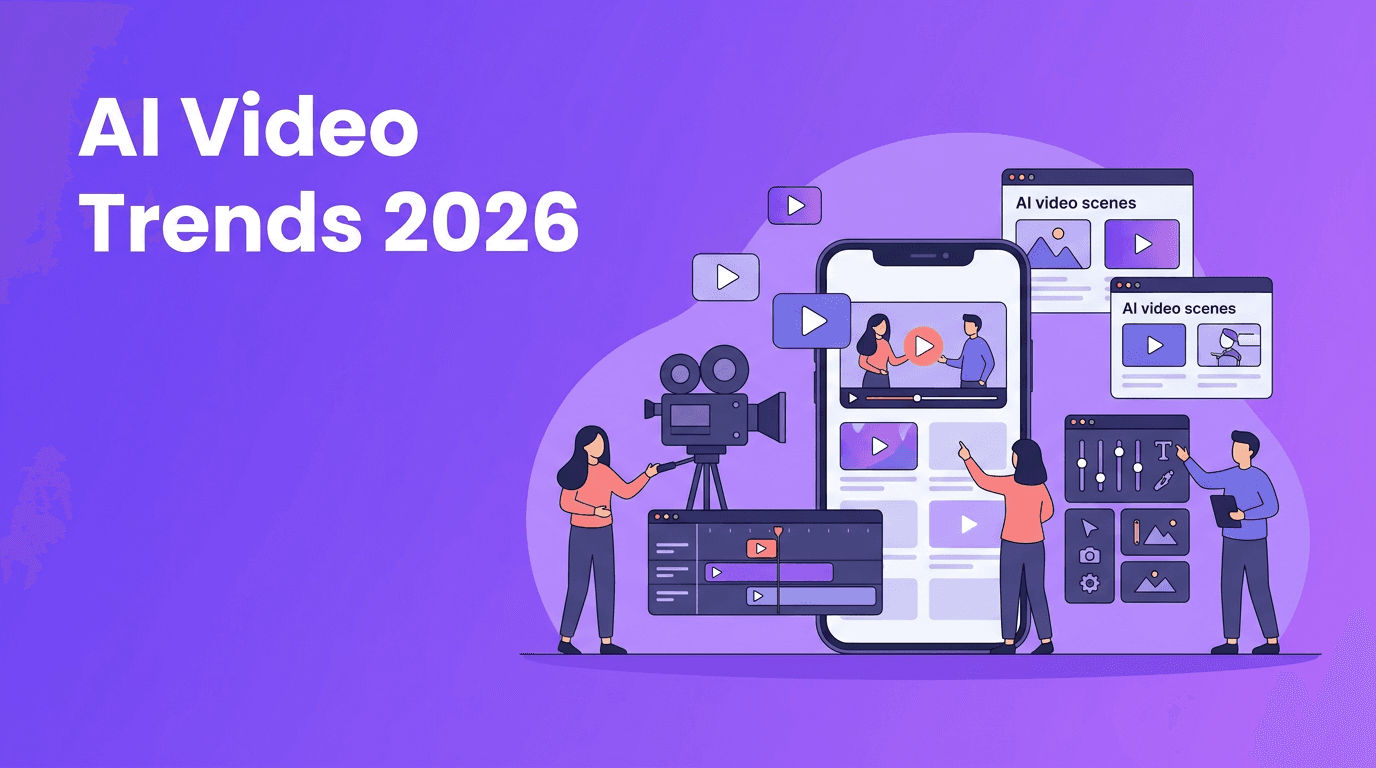
AI Video Trends 2026: What Sora, Veo, and Kling Mean for Creators
AI video trends 2026 are reshaping how creators, brands, and studios produce content. Here is what is happening now with Sora, Veo, Kling, quality gains, adoption, and where the future of AI video is heading.
By Movi AI Team
Movi AI Editorial Team
AI video trends 2026 are already taking shape now. Over the past year, the conversation has shifted from whether generative video works to how fast AI video technology is improving in realism, motion consistency, editing control, and creator usability. With headline models like Sora, Veo, and Kling pushing the market forward, creators and businesses are watching a new production stack emerge in real time.
What is happening now in the AI video industry
The biggest change in the AI video industry is that competition is no longer centered on short demo clips alone. Platforms are now being judged on AI generated video quality, prompt adherence, physics realism, camera motion, character consistency, and workflow integration. In 2024 and 2025, major players moved from research previews to more practical tools, while mobile-first apps like *Movi AI* made creation more accessible for everyday users who want text-to-video, image-to-video, video-to-video, and speech-to-video in one place.
- OpenAI Sora raised expectations for cinematic scene generation and world simulation.
- Google Veo emphasized high-quality output, prompt understanding, and integration with Google's creative ecosystem.
- Kling gained attention for strong motion realism and broader public curiosity around accessible high-end generation.
- Smaller platforms focused on speed, templates, avatar video, social content workflows, and mobile creation.
- The market is shifting from isolated generation to full idea-to-video pipelines with editing, sound, captions, and publishing support.
Sora vs other AI video models
When people search Sora vs other AI video, they are usually asking one practical question: which model is best for real use, not just impressive demos? Right now, each leading model has a different strength. Sora is associated with ambitious scene coherence and cinematic composition. Veo is tied to Google's multimodal ecosystem and strong prompt interpretation. Kling stands out for motion and visual dynamism that often feels immediately shareable.
How the top models compare today
- Sora: Strong brand recognition, advanced scene generation, and broad influence on how the market defines premium generative video.
- Veo: Competitive quality, enterprise relevance, and likely advantages when paired with Google's broader AI and creator tools.
- Kling: Fast-rising visibility, impressive motion output, and strong interest from creators looking for visually striking clips.
- Runway and similar platforms: Still important because they combine generation with editing, inpainting, and production workflows.
- *Movi AI*: Best suited for users who want practical mobile creation instead of a research-style interface, especially for fast social videos and creator-friendly workflows.
"The winners in AI video will not just generate beautiful clips. They will remove friction from the entire creative process."
That is why the debate over the best AI video generator 2026 will likely be less about a single model leaderboard and more about which platform gives users the fastest path from concept to publishable content.
Why AI generated video quality is improving so quickly
A year ago, many generated clips still suffered from rubbery motion, flicker, warped hands, broken object permanence, and weak temporal coherence. Today, AI generated video quality is improving because models are being trained on better multimodal data, longer context windows, and stronger world-modeling approaches. Developers are also adding more controls around camera movement, reference imagery, style locking, and iterative refinement.
- Temporal consistency is better, so characters and objects are less likely to mutate between frames.
- Prompt fidelity has improved, meaning outputs follow scene descriptions more accurately.
- Physics and motion look more believable, especially in walking, turning, and environmental interactions.
- Resolution and detail continue to improve, making outputs more usable for marketing and entertainment.
- Editing control is becoming a differentiator, with users expecting revisions instead of one-shot generation.
This progress matters because businesses do not need perfect Hollywood replacement technology to gain value. They need reliable outputs for ads, explainers, product teasers, social media, storyboards, and campaign variations. That is where current AI video news is most significant: useful quality is arriving faster than many expected.
Emerging use cases beyond hype
The future of AI video is being shaped by practical use cases happening now. Marketing teams are producing multiple ad variations from one concept. Ecommerce brands are turning product photos into motion assets. Educators are building lesson visuals faster. Game studios and filmmakers are using generative clips for previs and pitch development. Solo creators are testing formats that once required an editor, motion designer, and voice team.
Use cases gaining traction in 2025 and beyond
- Short-form social videos for TikTok, Reels, and Shorts
- Product marketing videos generated from images and prompts
- Localized content with different voiceovers, captions, and scenes by market
- Storyboard and previsualization for agencies, studios, and production teams
- Training and internal communications for enterprise teams
- Creator economy content where one person can produce at the pace of a small studio
Want to test these AI video trends yourself?
Create videos from text, images, speech, or existing clips with *Movi AI*. It is a fast way to turn ideas into polished content on mobile.
Download Movi AIIndustry adoption rates and market direction
Recent market reports across generative AI and creative tooling suggest strong enterprise experimentation and fast creator adoption, even if exact video-specific usage rates vary by source. Broadly, generative AI usage in business moved from pilot programs to department-level deployment during 2024 and 2025, and video is becoming one of the most valuable formats because it combines reach, engagement, and conversion power. This is a major signal for the AI video industry.
Several trends point to rising adoption: social platforms reward video heavily, brands need more content versions across channels, and production budgets remain under pressure. AI lowers the cost of iteration, which is often more important than lowering the cost of a single final asset. For creators, that means faster testing. For teams, it means more output without proportionally larger headcount.
- Many marketing teams now expect AI assistance in scripting, visuals, captions, and repurposing.
- Creator tools are adding video generation because static content alone is no longer enough.
- Enterprise buyers increasingly look for compliance, brand safety, and workflow integration, not just raw model quality.
- Mobile apps are expanding the market by making AI video technology usable outside desktop-heavy production environments.
How AI video is changing the creator economy
For the creator economy, the impact is straightforward: AI video technology lowers both the skill barrier and the time barrier. A solo creator can now turn ideas into animated explainers, cinematic clips, or promotional visuals without learning a full traditional editing stack. That does not eliminate creativity. It increases the value of strategy, taste, storytelling, and niche insight.
This shift will likely create two parallel creator advantages. First, creators who publish consistently will scale faster with AI-assisted production. Second, creators who develop a recognizable style will stand out as generated visuals become more common. In other words, speed becomes easier to buy, but creative direction becomes more valuable.
Predictions for the future of AI video
Looking ahead, the future of AI video will likely be defined by control, personalization, and integration. The next leap is not just prettier output. It is dependable output that fits real production needs.
- Longer coherent scenes will become more common as temporal consistency improves.
- Character consistency across multiple shots will move from premium feature to baseline expectation.
- Native editing inside generation tools will reduce the gap between generating and polishing video.
- Multimodal input will become standard, letting users combine prompts, images, reference clips, voice, and brand assets in one workflow.
- Personalized video at scale will expand in marketing, sales, ecommerce, and customer education.
- Mobile-first AI creation will grow quickly as creators expect studio-like power in simple apps such as *Movi AI*.
What to watch over the next 12 months
Watch for tighter links between generation and distribution, especially social publishing, ad testing, and analytics. Also watch for clearer distinctions between cinematic generation models and workflow-focused creator apps. That split will shape the race for the best AI video generator 2026, because different users want different outcomes: stunning showcase clips, or fast repeatable content production.
The most likely market outcome is not one model ruling everything. Instead, we will see specialized leaders: some for blockbuster-quality scene generation, some for enterprise media pipelines, and some for everyday creator speed. That is where *Movi AI* fits well, giving users a practical path to create and iterate quickly without needing a complex production environment.
Bottom line
The current wave of AI video trends 2026 shows a market moving from novelty to utility. Sora, Veo, and Kling have raised the ceiling for what generative video can look like, while creator apps are lowering the floor for who can use it. The result is a faster, more competitive, and more accessible video ecosystem. If quality keeps improving at the current pace, AI video will become a standard creative layer across marketing, media, education, and entertainment far sooner than most businesses planned for.
Frequently Asked Questions
What are the biggest AI video trends in 2026?+
The biggest AI video trends in 2026 include better temporal consistency, more realistic motion, multimodal workflows, stronger editing controls, and wider business adoption.
Is Sora better than other AI video tools?+
Sora is highly influential, but the best tool depends on your goal. Some platforms lead in cinematic quality, while others are better for speed, editing, or mobile content creation.
What is the future of AI video for creators?+
The future of AI video for creators is faster production, more experimentation, and easier access to high-quality visuals. Creative strategy and storytelling will become even more important.
How good is AI generated video quality now?+
AI generated video quality is improving quickly, especially in motion realism, prompt accuracy, and scene consistency. It is already useful for marketing, social content, and previsualization.
What is the best AI video generator in 2026?+
There will likely be different best options for different needs. Some tools will lead in cinematic generation, while others, like Movi AI, will be strongest for practical everyday creation and fast publishing.
Create stunning AI videos in seconds!
Turn your ideas into professional videos with the #1 AI video maker.
Download Movi AI